eSAF as a Stress Test for EU Decarbonisation Policy
Copyright: PtX Lab Lausitz / Sophie Kamrad
As part of EUSEW 2026, PtX Lab Lausitz discussed the importance of sustainable aviation fuels for European climate protection, competitiveness and security of supply.
On 10 June 2026, PtX Lab Lausitz and Transport & Environment (T&E) brought together EU institutions, industry and civil society at EUSEW 2026 in Brussels for a session that felt both timely and necessary.
The stress test: Where eSAF policy must hold
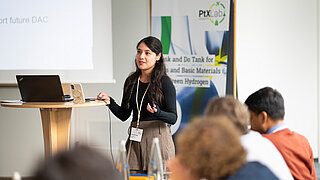
Felix Schmermer, Head of Section PtX Policy and Market Ramp-up at PtX Lab Lausitz, opened with a substantive diagnosis on the challenges. For eSAF to deliver, four conditions must hold simultaneously: certainty, affordability, supply and EU capability. If one link fails, SAF becomes a mandate without a market. Therefore, we really need to start right now.

Copyright: PtX Lab Lausitz / Toni Kretschmer
eSAF is no longer just an aviation issue, but a stress test of how to introduce a product that is currently not price competitive but is needed. If this is a success, it can be replicated in other sectors like shipping or the chemical industry.
From stress test to substance: the cost elephant in the room, project risks and the EU ETS
With panellists from the European Commission and across the eSAF value chain, the session moved quickly into substantive territory. The high price of eSAF and green hydrogen remains the central challenge to address.
De-risking investment was a recurring theme: the discussion examined whether the double-sided auction mechanisms currently being developed are sufficient, and ranged into more creative territory, including proposals such as frontloading ReFuelEU penalties to generate earlier revenue certainty for producers.
- Laurent Donceel (Hydrogen Europe): ‘E-kerosene is probably the most complex hydrogen derivative and the most expensive, compared to ammonia, methanol and other industries. So, we need to get the price done.’
- Gustav Granberg (IgnisP2X): ‘Lighthouse projects such as Eco2Fly demonstrate that Europe is building a competitive domestic eSAF industry. The immediate challenge is securing bankable offtake, and there is growing urgency to deploy market mechanisms, such as double-sided auctions, that can bridge the gap between producers and offtakers, unlock FIDs, and strengthen Europe's resilience and energy autonomy.’
The question of how upcoming review of hydrogen production criteria under AccelerateEU can deliver both regulatory clarity and climate integrity generated contested exchanges.
- Eddy Liégeois (European Commission): ʽWe need more flexibility for the production of hydrogen. Because we need to create a market and to make sure airlines remain competitive.’
The EU Emissions Trading System (ETS) revision produced equally sharp debate, with panellists holding genuinely divergent views on how international flights should be addressed and what that means for the competitiveness of European aviation sector:
- Aurelia Leeuw (Opportunity Green): ʽWe need to extend the EU ETS to international aviation. The ETS has shown that it can generate 50% emission reductions overall. But in aviationn it doesn’t do so, because it simply does not apply to the majority of the sector’s emissions.’
- Anna Sotianemi (Finnair): ʽWe see eSAF as a long-term opportunity for energy independence in Europe – homemade eSAF.’
Camille Mutrelle (T&E) summarised the main points of contention and concluded the discussion by outlining the necessary steps to be taken. A fitting conclusion to a topical and necessary discussion.
The PtX Lab Lausitz team thanks the panellists, Damien Meadows (European Commission) for moderating with precision and edge, and T&E for co-organising the discussion.
Contact
Felix Schmermer
Head of Section PtX Policy & Market Ramp-Up
+49 162 72 44 695
Write E-Mail
more information