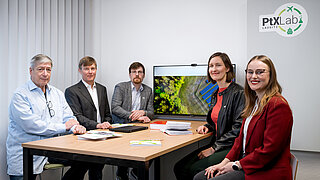
The German Government’s New Chemicals Agenda: From Short-Term Relief to Strategic Independence and Resilience
Copyright: VCI | Barbara König
The German government’s Chemicals Agenda, published on 26 March 2026, sends an important and timely signal: short-term relief measures for the chemical industry must be consistently linked to a long-term transformation strategy.
The transition to fossil-free production is crucial for reducing external dependencies whilst simultaneously strengthening competitiveness, resilience, security of supply and climate neutrality.
The PtX Lab Lausitz expressly welcomes the fact that the Chemical Industry Agenda clearly highlights the central role of hydrogen and its derivatives in this strategy. Competitive access to these resources – as well as the rapid expansion of the necessary infrastructure – is an essential prerequisite for a successful transformation.
Equally important is the significance of green lead markets as a key complementary instrument to the EU Emissions Trading System (EU ETS).
The PtX Lab Lausitz also welcomes the joint initiative by the Federal Government and the chemical industry to develop concrete proposals for the development of lead markets for climate-friendly raw materials and industrial products. It is particularly worth noting that this process builds on the stakeholder dialogue organised by the Federal Ministry for Economic Affairs and Climate Action in 2024 and is thus closely linked to the ongoing negotiations on the Industry Accelerator Act (IAA).
This development underscores the growing importance of European coordination in establishing strategic lead markets. Key platforms here are the Critical Chemical Alliance (CCA) and its working group on lead markets. As an active member of the CCA, the PtX Lab Lausitz regards this forum as crucial for shaping effective and scalable solutions at European level.
Discussions at the VCI Parliamentary Evening in Berlin
The aforementioned topics were also the focus of the Parliamentary Evening organised by the German Chemical Industry Association (VCI) on 25 March 2026 in Berlin. Dr Sarah Bernhardt, Head of Section PtX Basic Materials, took part in discussions there with representatives from politics, industry and associations.
The discussion once again highlighted that Germany as an industrial location – and the chemical industry in particular – is under considerable pressure. High energy costs, challenging investment conditions, regulatory complexity and intense global competition remain among the key challenges.
Against this backdrop, the PtX Lab Lausitz reiterates its clear position: Short-term relief measures must be closely linked to transformation goals. Only in this way can they lay the foundations for long-term competitiveness and resilience.
In recent publications, the PtX Lab Lausitz demonstrates how this can be achieved – through a balanced transformation approach based on clear political guiding principles.
Key priorities for implementing the Chemical Industry Agenda
Linking relief measures with transformation
Short-term support measures should contribute directly to long-term transformation pathways and not represent isolated, temporary solutions.Enabling competitive fossil-free energy sources
Affordable access to hydrogen and renewable energy is crucial to reducing dependencies and securing international competitiveness.Rapidly expanding infrastructure
The expansion of hydrogen, electricity and CCUS infrastructure must be accelerated to overcome key bottlenecks in industrial transformation.Creating and scaling up green lead markets
Lead markets are a key instrument for generating demand for climate-neutral chemicals and securing investment.Securing critical chemicals and value chains
Expanding domestic production capacities for strategically important chemicals strengthens resilience and economic security.Improving investment conditions
Reliable funding instruments, faster approval procedures and regulatory clarity are necessary to mobilise large-scale private investment.- Ensuring European coordination
National measures should be closely aligned with European initiatives – such as those on lead markets and the Industry Accelerator Act – to avoid fragmentation and maximise impact.
Contact
Dr
Sarah Bernhardt
Head of Section PtX Basic Materials
+49 173 56 150 72
Write E-Mail
more information