China Scales Up, Japan Waits: Asia Sets the Pace in the PtX Market
Copyright: gettyimages/MAGWIN
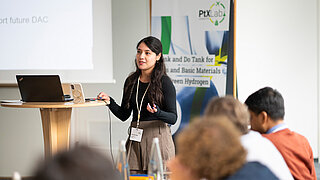
China has been producing green ammonia on an industrial scale, whilst Japan is focusing on ports and refineries rather than production. At PtX Lab Talk #20, it became clear that Asia is scaling up, whilst Europe is still debating.
Technological leadership in the PtX segment is increasingly shifting towards Asia – with direct consequences for German supply chains, export markets and the competitiveness of the industry.
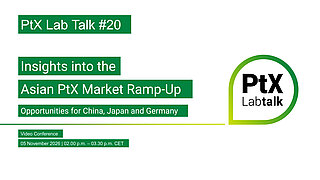
PtX Lab Talk #20, entitled “Insights into the Asian PtX Market Ramp-up – Opportunities for China, Japan and Germany” on 5 November 2026, contextualised this development and presented, for the first time, interim findings from the PtX Lab Lausitz project “PtX Technology and Market Radar Asia”. The project compares the state of the art and market conditions in Asia and Europe and derives policy recommendations from this – primarily for European decision-makers, but also useful for the strategic development of private providers of PtX technologies.
The focus was on three questions:
- How far have PtX developments progressed in Japan and, above all, in China, compared with German manufacturers?
- Where do opportunities for cooperation arise, and where do critical dependencies exist?
- What policy recommendations for action do these findings imply for the EU?
China: Vague Planning, Large-scale Implementation
China is one of the first emerging economies to have a concrete climate neutrality plan. A five-year plan sets out the economic ‘blueprint’. However, according to Linxiao Zhu (Policy Advisor, E3G), these plans remain vague: whilst they contain ambitious targets, the measures outlined are relatively unspecific.
Nevertheless, China is a global leader in the expansion of renewable energy and accounts for the largest share worldwide; the bottleneck now lies not on the supply side, but in integration and the grid.
Added to this are mega-projects as part of the national energy transition. These encompass not only large-scale production capacities but also the transformation of infrastructure – with ambitious targets such as 3,600 GW of renewable energy by 2035.
When it comes to PtX technologies, China is already capable of implementing large-scale projects for the production of green ammonia with a capacity of between 180,000 and 320,000 t/a, and of offering the product on the market at competitive prices and with RFNBO certification. This was reported by Dr Leo Diehl (Senior Project Manager/Consultant, Ludwig Bölkow Systemtechnik GmbH, LBST). China sei aufgrund seiner großen Ressourcen und klaren Nachfragesignale gut aufgestellt.
Japan: Expertise Yes, Infrastructure No
Leo Diehl and Esther Hegel (Technical Associate Director, Roundtable on Sustainable Biomaterials, RSB) both confirmed: Japan possesses the technological know-how but faces infrastructural challenges.
Due to the low potential for renewable energy in the island nation and its high dependence on imports, Japan will not assume the role of a large-scale exporter – but rather that of a technology hub, demand hub and system integrator. Japanese companies have demonstrated the production of carbon-based fuels on several occasions; however, no commercial project is planned.
In Japan, they wait for the market to develop first and then scale up; in China, on the other hand, they scale up first.
According to Dr Akiteru Maruta (Technova Inc.) Japan is not driven by supply-side factors and has no plans for large-scale implementation by 2030. However, there is a degree of certainty regarding domestic demand, as seven projects are set to continue over the next 15 years under Japan’s ‘CfD scheme’.
The approaches of the two countries differ fundamentally. “In Japan, they wait for the market to develop first and then scale up; in China, on the other hand, they scale up first,” said Leo Diehl.
Cooperation Rather than Self-sufficiency: The Division of Labour
In the long term, regional cooperation is a prerequisite for the market ramp-up of PtX fuels. The complementary strengths are obvious. “China brings economies of scale in renewable energy, industrial CO₂ and residual materials. Japan contributes demand, ports, refineries and certifications. At the same time, neither country currently has a binding SAF mandate or PtX-specific targets,” said Esther Hegel.
She added that the application of compatible regulatory frameworks, traceability and early pre-certification would ensure that current SAF regulations do not hinder future market ramp-up and that investors have confidence.
Video Recording of PtX Lab Talk #20
What this Means for Germany and the EU
China and Japan are pursuing opposing strategies: China is scaling up first and creating a fait accompli – including large-scale ammonia plants with an annual capacity of between 180,000 and 320,000 tonnes and the world’s largest methanol-to-jet plant, producing 280,000 tonnes of eSAF annually.
Japan is waiting for the market to develop, refining its technology and becoming a hub for demand and certification for imports. Together, these two countries demonstrate that PtX must be approached from a regional perspective: no single country in the region can do it alone.
For Germany and Europe, this means getting on board with the ramp-up not only technologically, but above all through regulation and certification – and using the period leading up to the mandatory start of CORSIA in 2027 to establish compatible rules and pre-certification.
Contact
Dr
Stefan Günthner
Head of Section PtX Technology
+49 152 564 637 13
Write E-Mail
more information
Contact
Minh Phuong Vu
Expert
+49 152 047 332 56
Write E-Mail
more information