The Net-Zero Framework for Shipping: Between Ambition and Fairness
Copyright: Evgenii Kovalev/gettyimages
Experts weigh the proposals for the IMO Net Zero Framework and ask how ambitious and fair a global climate plan for shipping can be.
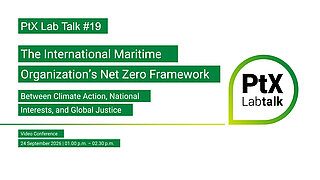
How ambitious can a global climate programme for shipping be when economic interests and geopolitical tensions collide? At PtX Lab Talk #19 on 24 September 2026 entitled "Net Zero Framework – Between Climate Action and Global Justice", experts discussed the proposals on the table for the IMO Net Zero Framework and the perspective of small island developing states (SIDS).
Shipping at a Turning Point
The Net-Zero Framework (NZF) of the International Maritime Organization (IMO) is meant to guide international shipping towards climate neutrality.Several proposals regarding its design and adoption are currently being negotiated. The next milestone is the Marine Environment Protection Committee (MEPC 85), which meets from 30 November to 3 December 2026.
Key Points of the Discussion
Em Fenton (Opportunity Green) gave a brief overview of the IMO GHG Strategy and the current negotiations. Fenton showed which proposals are on the table and which one Opportunity Green supports. The central point: the NZF must be designed so that the IMO's goal of net-zero emissions by around 2050 can actually be met.
Ambassador Albon Ishoda (Presidential Special Envoy for Maritime Decarbonization of the Republic of the Marshall Islands) presented the perspective of the small island developing states and 6PAC+, a Pacific-led alliance calling for a just and fair solution. According to Ishoda, effective climate action for island states is only possible if the IMO agrees to Tuvalu’s proposal. This proposal provides for stricter rules on the pricing of greenhouse gas emissions. The opposing Australian proposal is supported only with reservations.
Dr. Gilbert Kollenbach (PtX Lab Lausitz) assessed the proposals submitted in terms of their economic impact and their effects on the climate and the economy. Many of them can influence emissions noticeably, and Tuvalu's proposal has a particularly high impact. Economically, the proposals are sound but not yet efficient, so there is room for improvement in the negotiations.
Video Recording of the PtX Lab Talk #19
Conclusion: Ambition and Optimism in the Run-Up to MEPC 85
Em Fenton outlined the proposals on the table and stressed that the NZF must be designed so that the IMO's net-zero target for around 2050 can actually be met, while Ambassador Albon Ishoda presented the perspective of the small island developing states and 6PAC+, arguing that genuine climate protection for the island states is only possible if Tuvalu's proposal is adopted and supporting the Australian proposal only with reservations. Dr Gilbert Kollenbach assessed the proposals as economically sound but not yet efficient, noting that many of them, above all Tuvalu's, can noticeably affect emissions, and that the negotiations still leave room for improvement.
Contact
Anita Demuth
Head of Section PtX Mobility
+49 152 28 400 735
Write E-Mail
more information