How can we create stable markets for green chemicals?
Copyright: Critical Chemical Alliance
Reliable demand for manufacturers, affordable options for consumers: the new CCA report shows how leading markets for sustainable chemicals are emerging. The PtX Lab Lausitz was involved in the task force and is adding CCU to the debate.
How can Europe create markets for sustainable chemicals when suppliers need reliable demand in order to invest, whilst customers rely on affordable options to make the switch? Following more than six months of weekly discussions within the Critical Chemicals Alliance (CCA) Lead Markets Working Group’s task force, a new report sets out policy options to resolve this conflict of objectives. The PtX Lab Lausitz has played an active role in analysing and evaluating demand-driven policy instruments.
No single instrument is sufficient on its own
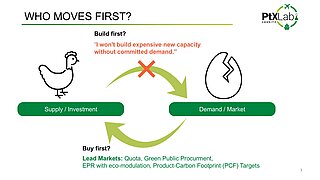
The European chemicals industry faces a classic chicken-and-egg problem: manufacturers will only invest if there is reliable demand, whilst downstream industries will only switch over if there are sufficient supply volumes at competitive prices. The recently published ‘Policy Options Package on Lead Markets’ therefore concludes that no single instrument can solve this challenge. Instead, the working group recommends combining measures to stimulate demand in specific end markets with cross-sectoral instruments and appropriate framework conditions. The key message is that planned demand can stimulate investment, scale up the supply of sustainable chemicals and help make new products competitive. The most important instruments include:
- Minimum requirements for sustainable carbon: the strongest support among the options for individual end markets, particularly for packaging and textiles
- Targets for the carbon footprint of products: a longer-term, technology-neutral approach
- Time-limited investment support: for example, through bilateral auctions using contracts for difference (CFDs)
Copyright: PtX Lab Lausitz
How can CCU contribute?
For the PtX Lab Lausitz, it is a key priority that captured CO₂ and renewable hydrogen can contribute to Europe’s transition away from fossil fuel sources. In the PtX Lab analysis ‘Creating Early Demand for CCU Chemicals’, a research group from the the Section PtX Basic Materials examines a specific CCU sub-quota within an overarching quota for sustainable carbon. The example scenario shows that a CCU sub-quota of 1.8 per cent for plastics in the packaging, automotive and construction sectors could generate an annual demand of around 0.7 million tonnes of CCU plastics by 2035 and support investments of between 8 and 13 billion euros.
The next step: turning recommendations into EU policy
At the CCA’s second General Assembly on 8 October 2026 in Creutzwald, France, the PtX Lab Lausitz was in attendance and continued its involvement in the alliance. The focus is now shifting to implementation. A joint non-paper from eight Member States of the European Union (EU) calls for the CCA’s recommendations to be translated into concrete measures, for example through the Industrial Accelerator Act, the Circular Economy Act and the Biotech Act II. PtX Lab Lausitz sees these legislative proposals as an opportunity to establish lead markets for sustainable chemicals, with CCU explicitly recognised alongside other sustainable carbon pathways.
Further discussion: Workshop in Cottbus
How well suited are the proposed instruments in practice to creating markets for PtX chemicals? The PtX Lab Lausitz will address this question on 27 November 2026 at the workshop ‘Reality Check for PtX Chemicals and Lead Markets’, held as part of the Sustainable PtX Conference in Cottbus (26 and 27 November 2026), together with Franklin Streichenberger from CO₂ Value Europe. Join the discussion and help shape the next generation of market-pull policies for PtX chemicals.
Contact
Lukas Horndasch
Expert
+49 162 72 444 92
Write E-Mail
more information
Contact
Dr
Henrik Basche
Expert
+49 173 207 54 56
Write E-Mail
more information